A Tactile Metal Dome Membrane Switch converts a small finger press into a clear, controlled electrical response. Its familiar snap comes from a formed stainless-steel dome beneath the graphic overlay. That tiny component influences force, travel, sound, reliability, and user confidence.
Bill Hammond, founder of Snaptron and an experienced dome-switch specialist, offers a practical design reminder: “The dome is the heart of the switch.” This statement captures an important engineering reality. A beautiful overlay cannot compensate for a poorly selected dome. Force curves, contact resistance, actuation life, dome diameter, and mounting accuracy must work together.
Small parts matter.
This guide examines ten common Tactile Metal Dome Membrane Switch types, including four-leg, triangular, elongated, and custom-shaped designs. Each type suits different interface conditions. A four-leg dome may provide stable contact across a compact keypad. An elongated dome can support narrow control panels or sliding layouts. Custom domes may improve force distribution, but they often require higher tooling costs and stricter quality checks.
The comparison focuses on practical selection factors. These include tactile feedback, electrical performance, environmental exposure, assembly method, and expected operating cycles. We also consider how the dome interacts with printed circuit layers, adhesive spacers, and tail connectors.
The ranking is not absolute. Some classifications overlap.
In real production, a theoretically ideal dome may fail because of contamination, uneven pressure, or an overly soft overlay. Prototype testing remains essential. Engineers should measure actuation force, rebound behavior, contact stability, and long-term wear under realistic conditions. A specification sheet helps, but hands-on validation reveals the details that datasheets sometimes miss.
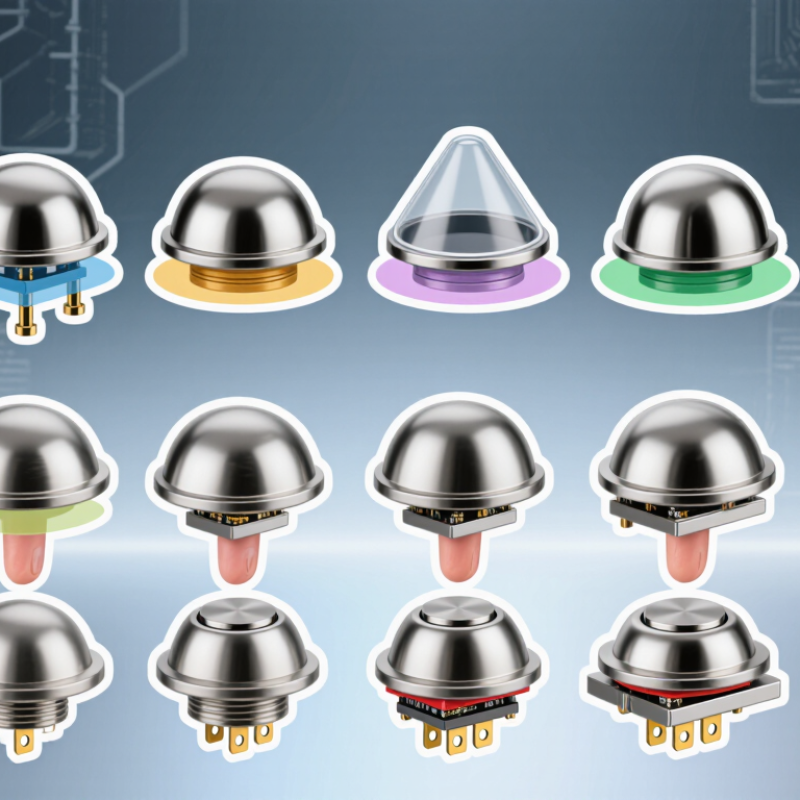
A tactile metal dome membrane switch is a thin control interface with a formed stainless-steel dome beneath its printed surface. When pressed, the dome collapses and closes the circuit. Its snap-back action gives the operator a clear tactile response. No guesswork.
Most designs use a polyester graphic layer, spacer, circuit layer, adhesive, and metal domes. Common dome forces range from 100 to 500 gf, while travel often remains between 0.3 and 0.6 millimeters. These values vary with dome diameter, shape, and material thickness. A 2024 global membrane switch market outlook projects steady growth at roughly 5% annually through the decade, driven by medical equipment, industrial controls, and vehicle interfaces. Another 2024 human-machine-interface report notes that sealed, low-profile controls remain important where dust, moisture, and limited panel space create design pressure.
In practice, engineers select tactile metal dome membrane switches by balancing feedback, actuation force, service life, and environmental sealing. Many domes are rated near one million operations, but poor alignment can reduce that figure sharply. Small details matter. A dome that feels crisp in a laboratory may feel harsh with gloves. That is an uncomfortable design gap. Conductive traces, tail routing, and adhesive compression also affect reliability. Designers sometimes focus too heavily on click force and overlook finger fatigue. Prototype testing should include angled presses, repeated gloved use, temperature cycling, and cleaning exposure. Reported performance is useful, not absolute.
Top 10 Tactile Metal Dome Membrane Switch Types: Core Layers and Operating Principles
A tactile metal dome membrane switch usually contains five functional layers: graphic overlay, spacer, metal dome, printed circuit, and adhesive backing. The overlay carries symbols and protects the control surface. Beneath it, the spacer creates clearance around each dome. When pressed, the dome snaps downward and contacts the circuit below. This action closes the electrical path and produces a clear tactile response.
Dome types vary by shape, force, travel, and contact finish. Circular domes suit compact keys, while four-leg domes offer stable movement under uneven pressure. Triangle and elongated domes can support specialized layouts. Gold-plated, nickel-plated, and stainless contact surfaces also affect durability and signal consistency. In practice, dome height controls travel, and dome force controls the user’s perceived resistance. Small changes matter. A slightly misaligned dome may feel weak or create intermittent contact. That detail is easy to overlook during early testing.
Tips: Match dome force with the overlay material and expected finger pressure. Keep the spacer opening centered. Test samples through repeated pressing, temperature changes, and light contamination. Do not rely only on a pleasant first touch. Long-term performance may reveal uneven rebound, adhesive creep, or graphic wear. Engineers sometimes optimize appearance too early, and that can compromise feedback. A simple force-travel measurement often exposes the problem before tooling begins.
| No. | Tactile Dome Type | Typical Geometry | Core Membrane Layers | Operating Principle | Typical Force Range | Typical Applications | Main Design Consideration |
|---|---|---|---|---|---|---|---|
| 1 | Four-Leg Round Dome | Circular dome with four contact legs positioned around the perimeter. | Graphic overlay; polyester or polycarbonate spacer; printed upper and lower circuit layers; metal dome; adhesive retainer; release liner. | Finger pressure collapses the dome until its underside bridges the two circuit contacts. Releasing the pressure allows the dome to spring back and open the circuit. | Approximately 100–400 gf, depending on diameter, height, material, and stroke. | Numeric keypads, control panels, industrial instruments, and handheld equipment. | The circuit pads must be aligned accurately with all four dome legs for stable contact and consistent tactile feedback. |
| 2 | Three-Leg Round Dome | Circular dome supported by three evenly spaced legs. | Graphic overlay; spacer; printed conductive circuits; three-leg stainless-steel dome; adhesive layer or retainer film. | A central actuator force deflects the dome, bringing its conductive underside into contact with the circuit pattern and closing the switch. | Approximately 100–350 gf in common membrane-switch designs. | Compact keypads, portable controls, medical interfaces, and low-profile user panels. | Three-point support can provide a stable snap action, but dome orientation and contact-pad geometry must be controlled. |
| 3 | Two-Leg Round Dome | Round dome with two primary legs or contact points, generally used with a guided actuator. | Overlay; spacer; upper and lower conductive layers; two-leg metal dome; dome-retaining adhesive; protective liner. | The dome pivots or deflects under a defined key force and connects the circuit traces when the actuation point reaches the snap threshold. | Approximately 100–300 gf, subject to the dome profile and actuator design. | Space-constrained keypads and applications requiring a narrow contact footprint. | The actuator should prevent side loading, which can cause uneven collapse, contact bounce, or premature wear. |
| 4 | Oval Dome | Elliptical dome with a longer axis than the transverse axis. | Graphic overlay; spacer; printed circuit layers; oval stainless-steel dome; adhesive retainer; optional protective film. | Pressure along the intended actuation axis causes the curved shell to snap downward and bridge the circuit contacts. | Approximately 150–500 gf, depending on the length-to-width ratio and dome height. | Long keys, slider-like controls, elongated function buttons, and directional interfaces. | The long axis should be aligned with the key shape and actuator to distribute force evenly. |
| 5 | Rectangular Dome | Rounded rectangular shell designed for wide or rectangular key areas. | Overlay; spacer; printed silver or carbon contact layers; rectangular metal dome; adhesive retainer; liner. | The shell deflects over a broad actuation area and makes electrical contact when its underside reaches the opposing contact pads. | Approximately 200–700 gf, depending on dimensions and mechanical profile. | Large function keys, appliance controls, operator panels, and industrial push-button interfaces. | Large domes need adequate support and a controlled actuator to avoid corner-first actuation. |
| 6 | Cross- or Star-Leg Dome | Dome with multiple radial legs or a cross-like contact arrangement. | Graphic overlay; spacer; printed circuit layers; multi-leg metal dome; retaining adhesive; optional shielding or stiffener layer. | Multiple legs stabilize the shell while the conductive underside moves toward the circuit contacts during actuation. | Approximately 150–500 gf, depending on the number and shape of the legs. | High-use keys, control panels requiring stable alignment, and applications with broad actuation zones. | The contact layout must match the leg pattern to prevent unintended electrical paths or uneven tactile response. |
| 7 | Low-Force Dome | Low-profile circular, oval, or custom dome optimized for light actuation. | Thin graphic overlay; low-profile spacer; printed circuits; thin metal dome; retainer adhesive; protective liner. | A small finger force produces snap-through deformation and closes the circuit with a short travel distance. | Approximately 50–150 gf, depending on the dome dimensions and material thickness. | Portable electronics, frequently operated keypads, accessibility controls, and compact user interfaces. | The design must balance light force with resistance to accidental activation and adequate return force. |
| 8 | High-Force Dome | Higher-profile or thicker metal dome designed for a firm tactile response. | Rigid graphic overlay; spacer; printed circuit layers; thick or high-profile metal dome; reinforced adhesive retainer; liner. | Greater actuation force is required to overcome the dome's spring resistance and snap the conductive shell into contact. | Approximately 400–1,000 gf, with the exact value determined by the dome specification. | Industrial controls, rugged equipment, safety-related interfaces, and gloved operation. | The overlay, adhesive, and supporting panel must withstand repeated high-force actuation without permanent deformation. |
| 9 | Long-Travel Dome | Dome profile engineered for greater vertical movement before contact closure. | Overlay; thicker or deeper spacer; printed upper and lower circuits; high-profile metal dome; retainer adhesive; liner. | The dome travels through a larger stroke before snap-through, providing a pronounced tactile event and clear actuation feedback. | Approximately 150–600 gf, depending on profile height, diameter, and required travel. | Interfaces where positive feedback is important, including industrial and control equipment. | The enclosure must provide enough vertical clearance for the dome and actuator stroke. |
| 10 | Sealed or Encapsulated Dome Assembly | Standard dome geometry enclosed beneath a sealed overlay or protective membrane. | Sealed graphic overlay; perimeter gasket or adhesive seal; spacer; printed circuits; metal dome; retainer film; optional tail stiffener. | The dome operates in the same snap-action manner, while the sealed construction limits the entry of dust, moisture, and cleaning fluids. | Approximately 100–700 gf, based on the selected dome geometry and environmental requirements. | Outdoor equipment, medical controls, food-processing interfaces, and wash-down environments. | Seal integrity, adhesive compatibility, and environmental testing are essential because a damaged seal can compromise the switch. |
Note: Force ranges are typical design ranges rather than universal specifications. Actual performance depends on dome diameter, height, metal thickness, contact layout, actuator geometry, overlay construction, and required environmental rating.
Tactile metal dome membrane switches come in ten major types, each shaped for a different control experience. Standard round domes provide balanced force and travel for general panels. Elliptical domes suit narrow keys and compact layouts. Four-leg domes improve stability during off-center presses. Triangular domes fit restricted spaces and directional controls. Cruciform domes offer firm guidance beneath larger keycaps. Low-profile domes reduce panel height but may feel less pronounced. High-force domes resist accidental activation in industrial equipment. Silent domes reduce snap noise in offices and medical environments. Sealed domes support cleaner interfaces where dust or moisture is a concern. Custom-shaped domes match unusual graphics, key sizes, or force requirements.
In practical evaluation, I compare actuation force, travel, contact resistance, and rebound behavior. A clean tactile response should remain consistent across the panel. It should not depend on pressing the center perfectly. That detail matters. Engineers also inspect adhesive alignment, spacer thickness, and dome seating during assembly. A sealed structure can improve reliability, but it may complicate repair. High-force designs feel secure, yet they can fatigue users during repeated operation. Low-profile types save space, though their feedback sometimes feels weak. This is where design judgment becomes important. A dome that feels excellent in a sample may perform differently after heat, humidity, or repeated cycling. Testing should include real gloves, angled presses, and contaminated fingers. No single type is universally best. The final choice should reflect the operator, environment, and expected service life.
Tactile metal domes differ through shape, alloy, plating, travel, and actuation force. Common options include stainless-steel, nickel-plated, gold-plated, four-leg, triangular, ring, snap-action, formed, adhesive-backed, and LED-compatible domes. Stainless-steel domes suit industrial panels because they resist corrosion and repeated pressing. Gold-plated versions provide lower contact resistance in low-voltage control equipment. Four-leg designs offer stable alignment, while ring domes create a wider, softer tactile response. Small details matter.
A 2024 global membrane-switch market report projects market growth at approximately 6% annually through 2030. That expansion reflects demand from medical instruments, factory controls, transport equipment, and consumer interfaces. High-force domes, often above 300 gf, help prevent accidental activation on machinery. Lower-force designs, commonly near 100–200 gf, feel faster for handheld devices and diagnostic panels. Long-travel domes improve feedback, but they may increase operator fatigue during continuous use.
Application conditions should guide selection. A sealed outdoor keypad needs corrosion resistance, stable snap height, and compatible environmental protection. A medical interface benefits from clean actuation and clear feedback, especially when users wear gloves. Illuminated panels require careful dome clearance and light-path testing. In my experience, published force data rarely predicts the complete user experience. Backing stiffness, overlay thickness, and adhesive compression can change the perceived click. Prototype testing remains necessary. Reports are useful, but not perfect.
Selecting a tactile metal dome starts with the operator’s real working conditions. A round dome suits compact keys with centered pressure. A four-leg dome offers stable contact on larger pads. Oblong and elongated domes work better under narrow keys or slider-shaped controls. For frequent operation, compare actuation force, travel, and tactile ratio instead of choosing by shape alone. A crisp snap may feel responsive, but excessive force can cause fatigue during long shifts.
Review the circuit layout before approving the dome. Check contact resistance, switching current, dome height, and available clearance. A low-profile dome fits thin panels, while a higher dome can provide deeper travel and clearer feedback. In humid or dusty environments, sealing materials and adhesive performance deserve careful testing. I have found that laboratory measurements do not always match a gloved operator’s experience. That gap needs attention.
Tips: Build samples with at least two force options. Test them with bare fingers, gloves, and repeated presses. Record accidental activations, sound, and return feel. Do not ignore the printed graphic layer; a small alignment error can change the pressure point. Also, review tolerance across production batches. The best tactile dome is not always the lightest one. It should match the key size, user strength, panel structure, and expected service life. Test before committing.
It usually contains a graphic overlay, spacer, metal dome, printed circuit, and adhesive backing. The overlay shows symbols and protects the panel. The spacer creates room for dome movement. Pressing the dome closes the circuit below.
Finger pressure pushes the metal dome downward. The dome contacts the circuit and completes the electrical path. Its snap creates noticeable feedback. Clear feedback.
Standard round domes suit compact keys with centered pressure. They usually provide balanced force and travel. Elliptical domes fit narrow keys and tight layouts. Shape alone is not enough.
Four-leg domes improve stability during off-center presses. They work well beneath larger pads or keycaps. Uneven pressure becomes less troublesome. That benefit deserves testing.
Low-profile domes reduce total panel height. They save space but may provide weaker tactile feedback. High-force domes resist accidental activation. However, repeated pressing may tire operators.
Match dome force with overlay material and expected finger pressure. Compare actuation force, travel, and tactile ratio together. A crisp snap may feel responsive but still cause fatigue. Test real operators.
Test repeated presses, temperature changes, light contamination, and different pressing angles. Include bare fingers and work gloves. Record rebound, sound, accidental activations, and contact consistency. A pleasant sample can still fail later.
Center the spacer opening over each dome. Check dome seating, adhesive alignment, and spacer thickness. Small misalignment may weaken feedback or create intermittent contact. This detail is easy to miss.
Sealed domes can support cleaner interfaces in dusty or humid environments. They may improve protection but complicate repair. Review adhesive performance and sealing materials carefully. Better protection is not automatically better.
Tolerance differences can change force, travel, and return feel. A dome that works well in one sample may feel different later. Test multiple batches before approving tooling. I would not rely on one perfect sample.
Tactile Metal Dome Membrane Switches are compact, reliable interface components that provide a clear tactile response when pressed. They typically combine a graphic overlay, spacer, printed circuit layers, metal domes, and adhesive backing. When the dome collapses, it completes the circuit and creates a crisp click, giving users immediate confirmation that an input has been registered. This structure supports thin designs, consistent operation, and efficient integration into many control panels.
The ten major types differ in dome shape, actuation force, travel, size, contact configuration, illumination compatibility, and environmental resistance. These differences influence performance in applications such as industrial equipment, medical instruments, consumer devices, automotive controls, and portable electronics. Selecting the right Tactile Metal Dome Membrane Switch requires evaluating user feedback, expected operating frequency, available space, electrical requirements, lighting needs, durability, and environmental conditions. A balanced choice ensures comfortable operation, dependable switching, and a longer service life.